AI Agents Broke Pricing. Here's How to Fix It.


Pricing the Agent, Not the Token
Imagine hiring a consultant under an unusual agreement: you settle on an hourly rate up front — that part's fine. But there's no estimate of how many hours the work will take, and no assurance on the result. You're agreeing to pay for effort, with no visibility into duration or outcome. Most businesses would walk away from that deal, no matter how reasonable the hourly rate sounds in isolation.
That's the deal most companies have quietly accepted with AI agents.
Pricing usually requires understanding multiples lenses of the offer and customers: what it costs to deliver, what profitability is expected, what alternatives are available, what the outcome might be worth, and what is the willingness to pay. Agentic AI is an offer where a seller can struggle to state most of these with confidence before the work is even done. That's not a failure of pricing imagination — it's a direct consequence of how agents work.
1. How agents work, and why the bill balloons
A simple AI query is one exchange: you ask, the model answers, done. An agent is different — it doesn't answer once, it cycles to work. Every agent loop moves through the same four phases, repeated as many times as needed: plan (decide what to do next), act (call a tool, query a database, edit a file), observe (read the result), and decide (repeat the loop, or stop). What changes from one agent to the next isn't the phases — it's how long that cycle runs, how tightly it's bounded, and who or what else gets pulled into it along the way.
Why the cost grows faster than the work
An agent has no memory between steps. Each new action re-sends everything that came before it — every instruction, tool call, and result — just so the model knows where it is. Step 10 doesn't just cost step 10; it costs steps 1 through 10, sent again in full.

A 20-step loop costs roughly 200× a single step, not 20×. Caching softens this — providers charge only about a tenth of the normal price to re-send text the model has already seen, so the real multiplier lands below 200× — but it doesn't remove it. The more steps a task needs, the more this multiplier matters. Tasks with short, bounded memory barely feel it. Tasks that need to remember a lot, for a long time, feel it directly in the bill.
No vendor can fully engineer this away — it's built into how these models work. Most of the worst real-world bills, though, come from something more fixable on top: agents with no step limit, no memory cap, and no checkpoint requiring approval before continuing.
What agents actually look like, in practice
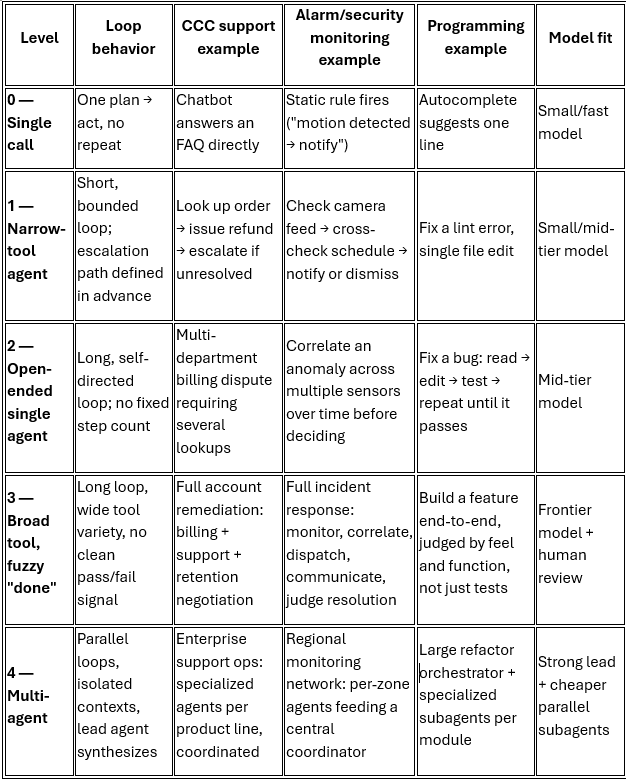
Before mapping cost to complexity, it helps to name the rough categories of agents you'll encounter:
Simple responders — one call, no loop (a chatbot answering a known question).
Narrow-tool agents — a short, bounded loop with a small, fixed set of tools and a clear escalation path.
Open-ended agents — a longer, self-directed loop with no fixed number of steps, deciding for itself when it's done.
Multi-agent systems — several agents working in parallel, coordinated by a lead agent that assigns work and synthesizes results.
One idea below comes from the industry: Anthropic draws a clear line between a "workflow" (a human decides every step in advance) and an "agent" (the model decides the steps itself). That's established. What's original in this article is what is proposed from that frame: breaking it into five levels of complexity, for each one, what drives cost and how it should be priced. No researched source pairs complexity and pricing this way — it appears to be original to this piece.
The reason it's useful: once a task's level is known, two things follow immediately — how tightly the memory problem will bite, and which pricing model actually has a chance of working. That turns a technical distinction into something operations and pricing teams can act on directly.
2. What the market has actually tried
Seats don't survive contact with variable cost — mostly
Traditional software pricing — a flat fee per user, per month — works when the cost of serving each user is roughly fixed. AI breaks that assumption directly: every query costs real compute, and that cost scales with usage, not headcount.
Kyle Poyar's State of B2B Monetization Report 2025, surveying 240+ software and AI companies, found pure seat-based pricing fell from 21% to 15% of companies in a single year, while hybrid pricing — a base fee plus a usage or outcome meter — rose from 27% to 41% over the same period. Separately, Bain & Company's October 2025 analysis of 30+ SaaS vendors introducing generative AI capabilities found roughly 65% had adopted hybrid pricing rather than abandoning seats outright.
Salesforce is a good example of how this plays out in practice. Agentforce launched charging $2 per conversation. Customers pushed back — the bill was too unpredictable to plan around. Salesforce then added a second option, Flex Credits, billing roughly $0.10 per action instead — more granular, but still open-ended. Customers still wanted a number they could put in a budget. So Salesforce added a third option: a flat per-user fee, starting around $125/month, with unlimited use included.
All three options are still on offer today. What that shows is exactly what finance teams keep asking for: a ceiling on the bill, alongside room to actually use the product without watching a meter. Pure usage pricing didn't survive that pressure. What's replacing it isn't a return to old-style seats — it's a seat-shaped ceiling wrapped around usage underneath, so buyers get predictability on top and flexibility below.
Outcome-based pricing: easy to pitch, hard to run
"Charge for the result, not the process" is the pitch every AI pricing conversation eventually arrives at — and on paper, it's the correct instinct: it aligns what the customer pays with what they receive. Venture-side research (Bessemer, a16z) frames this as the emerging standard, warning founders against defaulting to cost-plus pricing and instead pricing against value created. Kyle Poyar's own survey data puts a number on how aspirational this still is: only about 5% of software companies report their pricing model is outcome-based today, though roughly a quarter expect to get there by 2028.
The operational reality is measurably harder than the pitch. Zylo's 2026 SaaS Management Index (a survey of 218 IT leaders) found 78% had encountered unexpected charges tied to consumption-based or AI pricing in the past year. Separately, Flexprice's own research found 90% of CIOs cite cost forecasting as their top AI deployment challenge. (Zylo sells SaaS/consumption cost-management tooling and Flexprice sells AI billing infrastructure — both have a commercial interest in this problem existing, though the underlying survey findings are independently reported and consistent with each other).
Even organizations pioneering outcome-based pricing for their own services are finding it harder than it sounds. McKinsey's own consulting arm has reportedly moved a meaningful share of its fees to outcome-based arrangements — but reporting on that shift is careful to flag the unresolved mechanics: what baseline counts as "the outcome," who verifies it was met, and how the risk of missing it splits between buyer and seller. Outcome-based pricing needs an answer to all three before a single invoice is defensible. Most companies attempting it today don't have one yet.
Credits: the fastest-growing approach, and its real limits
Between "charge for time" and "charge for result" sits a third model that's growing fastest in practice: credits. Buyers purchase a pool of credits; different tasks consume different amounts, weighted roughly by expected cost. PricingSaaS's Q1 2026 report, tracking 498 SaaS companies, found the number offering credit-based pricing grew from 35 to 79 companies year-over-year — a 126% increase, though worth stating plainly off a base that small: it's a real and fast-moving directional shift, not yet a dominant model. It underlies products like Cursor and Perplexity, because it lets a seller absorb variable underlying cost without asking the buyer to accept a fully open-ended bill.
Credits solve a presentation problem more than a cost problem. They only feel predictable if credits-per-task are capped — without a cap, an unbounded agent still burns through an unpredictable number of credits, just in a friendlier-sounding currency. Vendors that shifted from unlimited to credit-based pricing without managing this carefully (Cursor and v0 both faced visible user backlash during their transitions) learned this directly: credits don't remove the underlying uncertainty, they repackage it, and buyers notice when the repackaging isn't paired with real bounds.
Where this leaves things
No single model currently "wins." Hybrid pricing has the most market share because it's the least demanding to implement and gives buyers a budgeable floor. Credits are growing fastest in relative terms because they feel tailored to AI's actual cost structure, off a still-small base. Outcome-based pricing has the most compelling logic but, at roughly 5% adoption, the least proven operational playbook outside a few narrow markets — which is exactly where customer care centers become useful evidence.
3. The proof case: customer care centers, and what makes a task priceable
If there's one market that has already made a version of outcome-linked pricing work, it's the customer care center (CCC) — let’s be clear of what's actually happening here is narrower than "outcome-based pricing" in the broad sense from Section 2: it's per-successful-transaction pricing, paying only when a single, well-defined ticket resolves — not pricing against a broader business outcome like retention or lifetime value.

A useful illustration of why per-conversation and per-resolution pricing land so differently comes from Fin's own published cost comparison: at their specific rates ($0.99 per resolution vs. $0.80 per conversation), per-conversation pricing only becomes the cheaper option once resolution rates climb to roughly 80%. That crossover point isn't a universal law — it moves depending on the exact prices being compared, and a different vendor pairing puts the same crossover closer to 35% — but the underlying mechanic holds everywhere: below the crossover, the buyer is effectively paying for failures. That's why vendors charging per resolution tend to have the more defensible model of the two.
Why does this market get to price this way when so many others can't yet? Because it has something most agentic use cases still lack: a known, priceable human alternative to reference. The figures here need a more honest caveat than they usually get: a widely-repeated pair of numbers — roughly $7.40 for a human agent resolution versus $0.62 for an AI resolution — circulates across vendor and industry content attributed to "McKinsey's 2026 data," ( I wasn’t able to find a published McKinsey document). What is independently and more traceably reported: McKinsey has cited an average inbound call cost of roughly $7.16, and other sources (MIT Sloan Management Review, Gartner) put human-agent interaction costs anywhere from $6 to $13.50 against AI costs of roughly $0.50 to $2. The directional gap — a human resolution costing several times more than an AI one — is well-supported across sources.
It's necessary to precise on what "anchoring to a human alternative" means, because it's easy to oversimplify: it does not mean charging what the human alternative costs, and it does not mean capturing 100% of the value created either. It means using the alternative's cost, time, and risk profile as a reference point, then adjusting for what the new offer does better or worse — speed, consistency, error patterns, accountability, trust. Working out where on that spectrum a fair price actually sits is exactly the kind of question that takes pricing and product teams months of market work and iteration to settle, even in mature, well-understood industries.
A useful example outside customer care centers: an AI monitoring agent replacing part of what a security monitoring-station operator does — watching camera feeds and sensor alerts, deciding what warrants escalation. The known human alternative has a known hourly cost, a known average response time, and a known escalation path. An AI agent doing this work can be priced against that reference — but not at parity with it, and not simply at a discount either. The agent may be faster and more consistent; the operator carries judgment, accountability, and liability the agent doesn't yet fully replicate. Pricing that gap correctly — not just acknowledging it exists — is the harder, iterative work.
Agentic AI adds one more layer of difficulty on top of that already-hard problem: in mature service industries, the inputs to that value discussion — effort, time, likely outcome — are knowable in advance. With most agentic tasks above the simplest tier, they aren't yet.
4. Why confidence collapses above the simplest agent tasks
Customer care center agents, and the alarm-monitoring example above, sit near the bottom of the complexity table in Section 1: narrow tools, short loops, and a real human alternative to anchor against. Most other agentic work doesn't have that combination.
Coding agents are the sharpest evidence of what happens once loops get long and open-ended. Gartner's own research describes AI coding costs as introducing highly variable cost structures, with many vendors lacking transparency into how token consumption is calculated and billed. Gartner has documented real bills leaping from $20-$100 to $2,000-$5,000 per developer per month, with extreme cases reaching $20,000 — and forecasts that by 2028, AI coding costs will overtake the average developer's salary if current consumption trends continue. Gartner's own prescribed fix is telling: align model choice with task complexity, breaking work into smaller pieces smaller, cheaper models can handle — a version of exactly the "bound the loop" principle this piece has been building toward.
Beyond coding, the broader agent market shows early, uneven maturity rather than settled practice. Forrester's own research notes that while a large majority of enterprise leaders report adopting agentic AI, only a small minority have it running in meaningful production beyond basic chatbot-style deployments — genuinely scaled multi-agent systems remain rarer still. That gap between adoption and maturity is itself a pricing signal: the market hasn't converged on how to price something it hasn't yet learned to run reliably at scale.
The common thread: above the simplest agent tasks, loops are open-ended, there's no clean pass/fail signal for "done," and there's no known human alternative to anchor a price against. Without that anchor — and without the effort/time/outcome inputs mature service industries take for granted — both outcome-based and pure consumption pricing are guessing, just with different amounts of confidence in the guess.
5. The recommendation
The dividing line isn't the technology's sophistication — it's whether a bounded loop and a real value anchor both exist.
Below that line — narrow-tool agents with short, predictable loops and a nameable human alternative — outcome-based, hybrid, and credit pricing all can work, and customer care centers have already shown it, provided the harder work of pricing the gap to that alternative has actually been done. Above that line — open-ended agents, broad tool use, fuzzy success criteria, or multiple agents coordinating — none of these models can yet be trusted without an added layer of discipline: hard caps on steps or context, and approval gates before costs escalate further.
This isn't only a pricing problem. It's what happens when a process has no boundary: the cost becomes impossible to control, and once that happens, the only pricing model left standing is cost-plus — bill for whatever it took, plus a margin. That combination, an unbounded process priced cost-plus, has a long and expensive history outside of software. Government infrastructure projects run over budget for exactly this reason. The F-35 fighter jet program, priced this way for years, ran hundreds of billions of dollars past its original estimate. That model is already a known failure. The fix isn't a cleverer formula. It's the same two things this piece keeps coming back to: close the loop, and price against a real alternative.
Acknowledgments
Thanks to Ronald Ayala, Masters in AI from University of Houston, for his input as technical AI consultant on this piece.
Sources
Anthropic, "Building Effective Agents" — engineering.anthropic.com
Anthropic, "How we built our multi-agent research system"
Anthropic, "Effective context engineering for AI agents"
Anthropic API pricing documentation, prompt caching mechanics (2026)
Kyle Poyar, "The State of B2B Monetization in 2025," Growth Unhinged (survey of 240+ companies, April–May 2025)
Bain & Company, "Per-Seat Software Pricing Isn't Dead, but New Models Are Gaining Steam" (October 2025)
PricingSaaS, Q1 2026 Trends Report (498 tracked SaaS companies)
Zylo, 2026 SaaS Management Index (survey of 218 IT leaders)
Flexprice, industry research on AI cost forecasting
Gartner, "With AI Agents, You Need a New Way to Calculate Cost and Value" (Rita Sallam, Jan 2, 2026)
Gartner newsroom, AI coding agent cost forecasts (2026)
Gartner newsroom, "Agentic AI puts enterprise SaaS spending at risk"
Forrester, agentic AI enterprise adoption research (2026)
Bessemer Venture Partners, "The AI Pricing Playbook" (2026)
Reporting on McKinsey's own outcome-based consulting fee shift (Business Insider, Financial News, Hunt Scanlon, 2026)
Salesforce Agentforce pricing pages and third-party breakdowns (eesel AI, ZenML, SaaStr, 2026)
Fin.ai, published per-resolution vs. per-conversation cost comparison (2026)
CCC vendor pricing pages: Intercom Fin, Zendesk, Quickchat AI, Gorgias
MIT Sloan Management Review and Gartner, human vs. AI customer-service cost benchmarks (ranges cited, not point figures)
A note on process
This article was conceived, structured, and directed by Jorge Mario Rodriguez. AI tools were used throughout the research and editing process — sourcing and verifying data, checking citations, and tightening prose — under the author's direction and review. The framework, arguments, and conclusions are the author's own.


Comments